
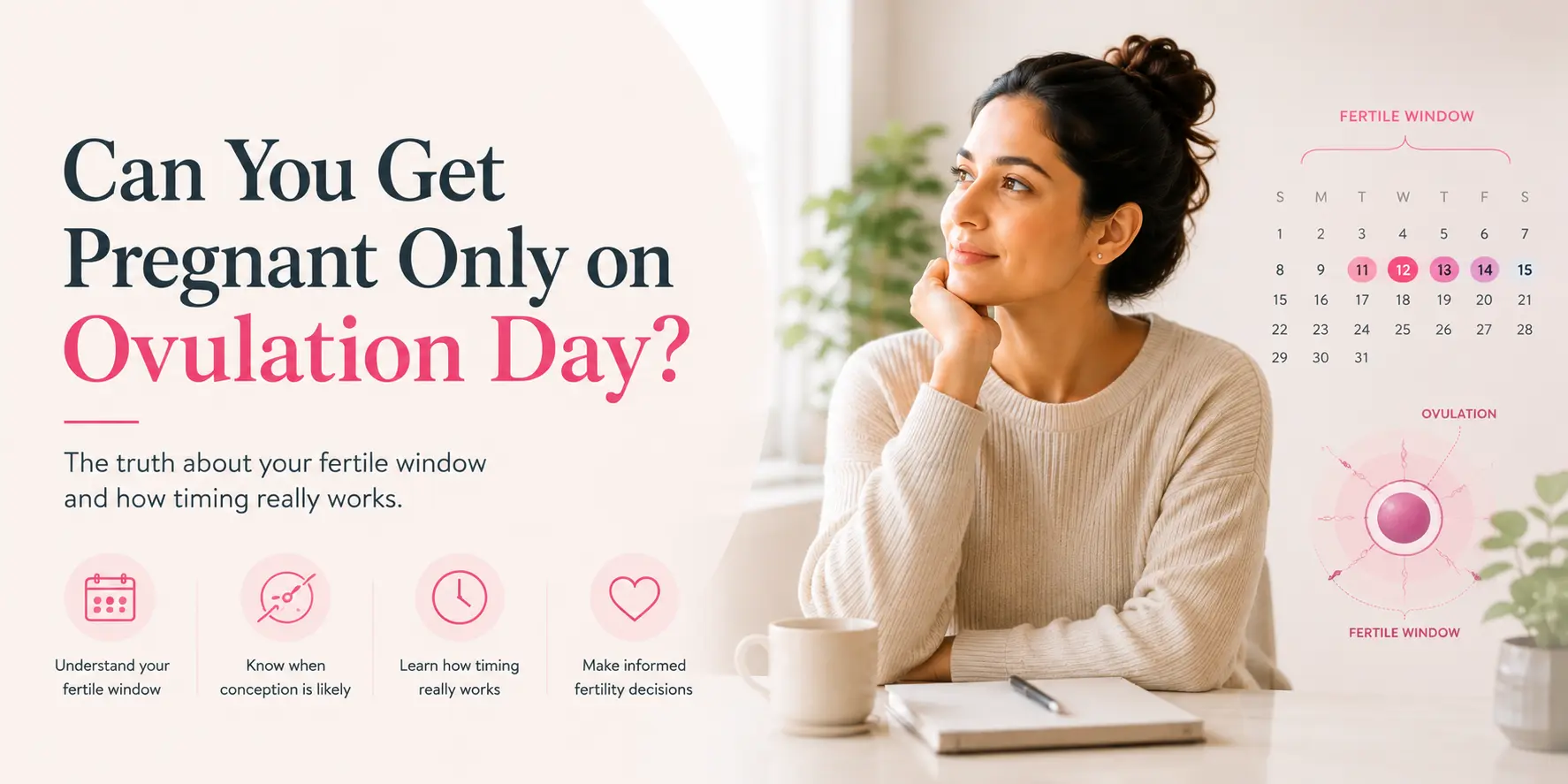
Can You Get Pregnant Only on Ovulation Day?
It's one of the most common assumptions about conception: that pregnancy can only happen on the exact day of ovulation. If you've been trying to time things precisely around that one day, you might be wondering if you're missing your chance every other day of the month.
Here's the good news: ovulation day isn't the only day pregnancy can happen. In fact, it's often not even the day with the highest chance of conception.
The Short Answer
No, pregnancy isn't limited to ovulation day alone. While ovulation, the release of an egg from the ovary, is a key part of the process, conception can also result from intercourse that happens in the days leading up to ovulation. This is because of how long sperm can survive inside the body compared to how long the egg remains viable after release.
Understanding this difference is the key to understanding your fertile window.
Why Ovulation Day Isn't the Whole Story
To understand why pregnancy can happen on days other than ovulation day, it helps to look at two separate timelines:
The egg's lifespan is short. Once released during ovulation, an egg is typically viable for fertilization for around 12 to 24 hours. If it isn't fertilized within that window, it breaks down and pregnancy won't occur that cycle.
Sperm can survive much longer. In the presence of fertile cervical mucus, sperm can survive in the reproductive tract for several days, commonly cited as up to 5 days, sometimes longer in rare cases. This means sperm from intercourse that happened days before ovulation can still be present and viable when the egg is released.
Put these two timelines together, and you get what's known as the fertile window, a span of days where pregnancy is biologically possible, not just a single 24-hour period.
What Is the Fertile Window, Exactly?
The fertile window is generally considered to span the 5 days before ovulation through the day of ovulation itself, with the highest chances of conception typically falling in the 1–2 days immediately before ovulation and on ovulation day.
For someone with a textbook 28-day cycle (where ovulation occurs around day 14), this means the fertile window roughly spans days 9 through 14, though individual cycles vary, sometimes significantly.
This is why many fertility awareness and conception-focused approaches encourage couples to think in terms of a fertile window, rather than a single fertile day.
So When Are the Chances Highest?
While conception is possible throughout the fertile window, research generally points to the one to two days before ovulation as the period with the greatest likelihood of pregnancy, slightly ahead of ovulation day itself.
This makes sense biologically: if sperm is already present and waiting when the egg is released, fertilization can happen almost immediately. Intercourse on ovulation day can certainly still result in pregnancy, but it isn't necessarily the single best-timed day, contrary to the common assumption.
Why This Matters If You're Trying to Conceive
If you've been focusing all your efforts on pinpointing ovulation day itself, this information might shift how you think about timing:
Tracking ovulation is still valuable, but the goal is to identify your fertile window, not just a single day
Timing intercourse across several days leading up to and including ovulation may offer a better chance than focusing on one day alone
Cycle length varies, even for people who consider their cycles "regular," so ovulation prediction methods (like ovulation predictor kits, cervical mucus changes, or basal body temperature tracking) can help narrow down your personal window
Irregular cycles can make this timing harder to pinpoint, which is where understanding your broader reproductive health becomes especially useful
None of this means you need to track every detail perfectly. For many people trying to conceive, having a general sense of their fertile window, rather than fixating on one exact day, can ease pressure while still supporting their goals.
When It Might Be Worth a Closer Look
If you've been tracking your fertile window and timing intercourse accordingly for several months without success (12 months generally, or 6 months if you're over 35), it may be a good time to speak with a healthcare provider. This is especially true if you also experience irregular cycles, very short or long cycles, or other symptoms that might suggest an underlying hormonal factor.
Understand Your Own Cycle
Every person's cycle is different, and understanding your own patterns is far more useful than relying on a one-size-fits-all rule. SORA's free tools can help you get a clearer picture of where you stand.
Try the Ovulation Calculator →
If you'd like a broader look at your reproductive health and fertility timeline, SORA's Fertility Assessment offers a private, evidence-based starting point.
Explore the Fertility Assessment →
This article is intended for educational purposes only and does not constitute medical advice. For personalized guidance, please consult a qualified healthcare provider.
Wondering about your timing?
Estimate your fertile window to optimize your chances of conceiving. Try the free Ovulation Calculator.
Frequently Asked Questions
Can you get pregnant only on ovulation day?
No. While ovulation is central to conception, pregnancy can also result from intercourse in the days before ovulation, since sperm can survive in the body for several days while waiting for the egg to be released.
What is the fertile window?
The fertile window is the span of days in a menstrual cycle when pregnancy is possible. It typically includes the 5 days before ovulation and the day of ovulation, with the highest chances often in the 1–2 days before ovulation.
How long does an egg live after ovulation?
An egg is generally viable for about 12 to 24 hours after release. If it isn't fertilized within that time, pregnancy won't occur that cycle.
How long can sperm survive in the body?
In fertile cervical mucus, sperm can commonly survive for up to 5 days, occasionally longer, though this is less common.
What if my cycles are irregular?
Irregular cycles can make it harder to predict ovulation and the fertile window using calendar-based methods alone. Tracking signs like cervical mucus changes or basal body temperature, or speaking with a healthcare provider, may help.
Related Articles

Can You Get Pregnant Naturally with Low AMH? What You Need to Know
A low AMH result can feel alarming, but it's not the same as a diagnosis of infertility. AMH mainly ...
Read Article
What Is Fertility? Understanding Your Reproductive Health
Fertility refers to your natural ability to conceive a child, depending on factors like regular ovul...
Read Article